Who Is Prince Hall? Father of Black Masonry in the United States
Prince Hall is recognized as the Father of Black Masonry in the United States. Historically, he helped make it possible for Black men to be recognized and enjoy the privileges of Free and Accepted Masonry.
Prince Hall: September 12, 1748 – December 4, 1807
Prince Hall is remembered as a pioneering figure in American Freemasonry and as a leader whose efforts opened a path for Black men to participate in the rights, traditions, and privileges of Free and Accepted Masonry.
Many details of his early life have been debated over time. The original Smooth Ashlar page notes that some records and papers connect him to Barbados, where it was rumored he was born in 1748, but no confirmed birth record by church or state has been found there or in Boston. It also notes that the available counties and churches with baptismal records were searched without finding his name.
One widely repeated account states that Prince Hall was free born in the British West Indies, that his father was Thomas Prince Hall, an Englishman, and that his mother was a free woman of color of French extraction. According to this account, he came to Boston in 1765, worked as a leather worker, married Sarah Ritchey, lost her shortly after their marriage at age 24, later acquired real estate, and became qualified to vote.
The original page also includes the tradition that Prince Hall pressed John Hancock to allow Black men to join the Continental Army, that he was among the Black men who fought at the Battle of Bunker Hill, and that he later became a minister connected with the African Methodist Episcopal Church in Cambridge while also fighting for the abolition of slavery. It notes that some of these accounts are connected to the generally discredited Grimshaw book of 1903.
The path to African Lodge #459.
Initiated into Masonry
During the War of Independence, Prince Hall and fourteen other free Black men were initiated on March 6, 1775, into Lodge #441, Irish Constitution, attached to the 38th Regiment of Foot, British Army, at Castle Williams in Boston Harbor. The Master of the Lodge was Sergeant John Batt.
Petition for a Charter
On March 2, 1784, Prince Hall petitioned the Grand Lodge of England through William Moody, Worshipful Master of Brotherly Love Lodge #55 in London, for a warrant or charter that would allow African Lodge to operate with full Masonic authority.
African Lodge Organized
The warrant was granted on September 29, 1784, delivered in Boston on April 29, 1787 by Captain James Scott, and African Lodge #459 was organized one week later, on May 6, 1787, with Prince Hall serving as its first Master.
The founding of Black Masonry in America
Freemasonry among Black men began during the War of Independence, when Prince Hall and fourteen other free Black men were initiated on March 6, 1775, into Lodge #441, Irish Constitution, which was attached to the 38th Regiment of Foot, British Army, garrisoned at Castle Williams, now known as Fort Independence, in Boston Harbor. The Master of the Lodge was Sergeant John Batt.
Along with Prince Hall, the other newly made Masons included Cyrus Johnson, Bueston Slinger, Prince Rees, John Canton, Peter Freeman, Benjamin Tiler, Duff Ruform, Thomas Santerson, Prince Rayden, Cato Spain, Boston Smith, Peter Best, Forten Howard, and Richard Titley.
When the British Army left Boston, Lodge #441 gave Prince Hall and his brethren limited authority to meet as a Lodge, participate in processions on Saint John’s Day, and bury their dead as Masons. However, they were not permitted to confer degrees or perform other Masonic work. For nine years, these brethren, together with others who had received their degrees elsewhere, assembled and enjoyed their limited privileges as Masons.
On March 2, 1784, Prince Hall petitioned the Grand Lodge of England through William Moody of Brotherly Love Lodge #55 in London for a formal warrant or charter. The warrant was granted on September 29, 1784, under the name African Lodge #459 on the register of the Grand Lodge of England by authority of the Duke of Cumberland. It was delivered in Boston on April 29, 1787 by Captain James Scott, brother-in-law of John Hancock and Master of the Neptune. African Lodge was organized one week later, on May 6, 1787, with Prince Hall as its first Master.
The warrant for African Lodge #459 became one of the most important documents in the Prince Hall Masonic tradition. Through that charter, the legitimacy of Masonry among free Black men in America was traced and preserved. The original page notes that the charter is authenticated, kept in safekeeping, and believed to be the only original charter issued from the Grand Lodge of England still in possession of any Lodge in the United States.
African Lodge later fell into arrears in the late 1790s and was stricken from the rolls after the Union of 1813, although it had attempted correspondence in 1802 and 1806. In 1827, after further unanswered communication, African Lodge declared its independence and began calling itself African Grand Lodge #1.
It is also important to note that when the Massachusetts lodges operating as a Provincial Grand Lodge declared themselves an independent Grand Lodge, and when the present Grand Lodge of Massachusetts was later formed by amalgamation, African Lodge was not invited to take part even though it held a warrant every bit as valid as the others.
The question of extending Masonry arose when Absalom Jones of Philadelphia, an ordained Episcopal priest and Mason, appeared in Boston in 1791 with interest in establishing a Masonic Lodge in Philadelphia. Delegations also traveled from Providence, Rhode Island, and New York to establish the African Grand Lodge that year. Prince Hall was appointed Grand Master and served in that capacity until his death in 1807.
The charter and the continued legacy.
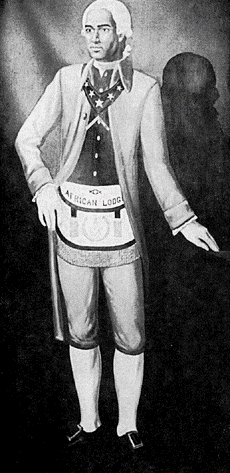
After Prince Hall’s death, leadership continued through several Grand Masters. Nero Prince became Grand Master, and when he sailed to Russia in 1808, George Middleton succeeded him. After Middleton, Peter Lew, Samuel H. Moody, and John T. Hilton served in leadership. In 1827, Hilton recommended a Declaration of Independence from the English Grand Lodge.
In 1869, a fire destroyed the Massachusetts Grand Lodge headquarters and many priceless records. The original charter was in its metal tube inside the Grand Lodge chest. The tube saved the charter from the flames, but the intense heat charred the paper. Grand Master S.T. Kendall crawled into the burning building and, at great personal risk, saved the charter from complete destruction.
That act of devotion further consecrated the parchment and added another important detail to its history. The original Charter #459 was later made secure between heavy plate glass and kept in a fireproof vault in a downtown Boston bank.
In the twentieth century, questions of recognition continued. In 1946, the Grand Lodge of England again extended recognition to the Prince Hall Grand Lodge but withdrew it the same year. In 1994, the Grand Lodge of England accepted a petition for recognition by the Prince Hall Grand Lodge of Massachusetts.
The original page explains that recognition had been withheld for reasons including territorial boundaries, because the Grand Lodge of England had already recognized the white Grand Lodge of Massachusetts in the same jurisdiction, and questions about back dues owed to the Grand Lodge. It also notes that, two hundred years earlier, dues were often carried by sailing ship captains, and money could be delayed or lost, making it difficult to prove with certainty that all dues had been paid.
The ties were arranged to be formalized in June 1996. In its long history, the Prince Hall Grand Lodge tradition has helped form over 44 other Grand Lodges, with subordinate Lodges receiving recognition once their Grand Lodges are recognized.
Prince Hall is buried in Boston, in a cemetery overlooking the Charlestown naval yard in the city’s north end. His grave is located near a large tree, with his wife’s grave situated directly behind his.
Serving Murrieta, Temecula, and the surrounding community.
Smooth Ashlar Lodge #119 continues the work of Prince Hall Freemasonry through fellowship, service, and active involvement.
Member dues made simple.
Use the buttons below to pay quarterly or annual dues through the secure payment pages.